
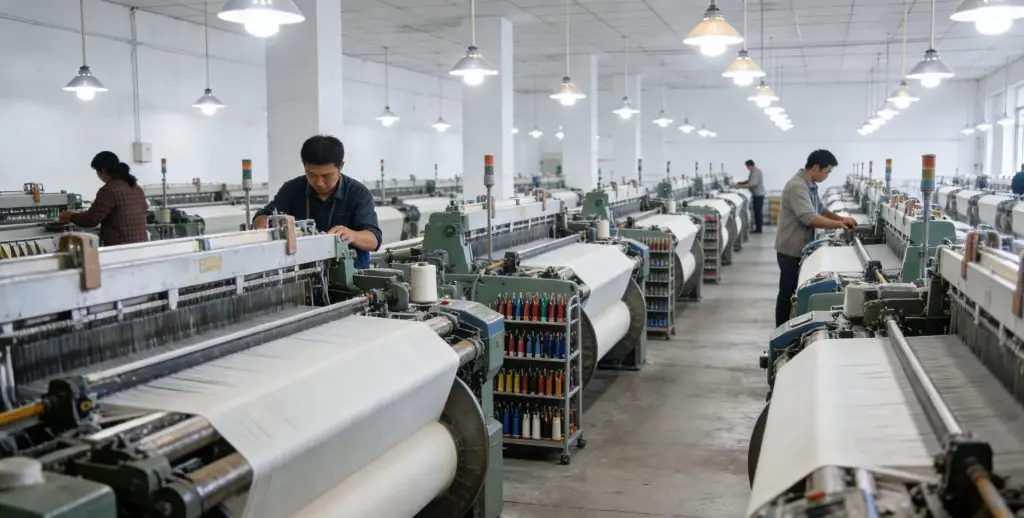
Humidity control is crucial for the textile industry. Proper air humidity can reduce fiber electrostatic charges, decrease yarn breakage rates, enhance fiber flexibility and strength, and make the spinning and weaving processes smoother and more stable. It can also reduce flyaway fibers and dust, lower equipment failure rates and product defect rates, improve production efficiency and product quality, and ensure a stable production environment.
In this article, we’ll explore why textile mills use industrial humidifiers, the benefits of proper humidity control, and how the right humidification system can optimize cloth production.
Why is humidity control so crucial for the textile industry?
Textile fabrics are typically composed of cellulose-based fibers (such as cotton and hemp) or synthetic fibers like polyester. These materials are highly sensitive to air humidity. Natural fibers have hygroscopic properties; when the humidity is too low, they lose moisture, become brittle, and their strength decreases, making them prone to static electricity and yarn breakage. Synthetic fibers are more susceptible to accumulating static electricity in dry environments, which can affect the stability of spinning and weaving processes. Generally, the optimal relative humidity for textile workshops is around 55% to 65%. Within this range, it enhances fiber flexibility and spinnability, reduces flyaway and breakage rates, and ensures fabric quality and production efficiency. Improper humidity control can lead to increased static electricity, yarn breakage, an increase in fabric defects, and even affect equipment operation and product quality stability.
What are the primary challenges posed by low humidity for the textile industry?
1. Electrostatic issues are severe
When the air humidity is too low, static electricity can easily form and accumulate between the fibers, causing them to repel each other or adhere to the surface of equipment. This results in unstable fiber operation and hinders the smooth progression of processes such as spinning, weaving, and winding.
2.Increased yarn breakage rate
In dry environments, the moisture content of fibers decreases, leading to reduced flexibility and increased susceptibility to brittleness. This results in lower strength and tensile properties of the yarn, making it more prone to breaking during processing and increasing the frequency of downtime.
3. Increased amounts of flying particles and dust
In low-humidity environments, fibers are difficult to adhere to the yarn. Fine fibers are prone to falling off the yarn and drifting through the air, resulting in a large amount of flying debris. This not only affects product quality but also pollutes the production environment.
4. Decreased fiber spinnability
When fibers lack sufficient moisture, their bonding strength weakens, making it difficult for fibers to bond closely together. This results in instability during the spinning process, increasing production challenges and affecting the uniformity of the yarn.
5. Increase in quality issues with fabrics
Due to issues such as electrostatic discharge, broken ends, and fiber instability, there is a risk of developing quality defects like fabric imperfections, uneven yarn density, and inconsistent yarn tension, which can lower the product’s grade.
6. Production efficiency and equipment operation are affected
Frequent interruptions caused by broken threads, the need to clear loose fibers, and electrostatic interference with equipment all contribute to increased downtime, reduced productivity, and higher costs for equipment maintenance and cleaning.
Benefits of Industrial Humidifiers in Textile Mills
Installing an industrial humidification system provides several key advantages for textile manufacturers:
Anti-static properties
- In textile workshops, drying processes are prone to generating static electricity, which can cause yarns to become contaminated with dust or to break apart.
An air humidifier can help increase the humidity in the air, thereby significantly reducing the risk of static electricity.
Protect the quality of fibers
- Appropriate humidity levels help maintain the elasticity of fibers such as cotton, hemp, and synthetic materials, reducing breakage and damage to yarns.
Increase production efficiency.
- This will help reduce issues such as static electricity, broken ends, and broken threads, decrease downtime for repairs, and increase production output.
Improve the work environment
- Proper humidity levels reduce the amount of dust in the air, making it more comfortable for workers to breathe and improving their productivity.
Save on energy costs
- By controlling humidity, we can reduce the frequency of equipment failures, thereby minimizing downtime losses and material waste.
Extend the lifespan of equipment
A dry environment can accelerate the wear and tear of machine components, while moderate humidity can extend the lifespan of textile equipment.
Types of Industrial Humidifiers Used in Textile Mills
Different humidification technologies are used depending on factory size and production requirements.
High-Pressure Mist Humidifiers
The water is converted into fine mist particles of 5–15 micrometers in size using a high-pressure pump, which quickly evaporates in the air to increase humidity.
It has a large coverage area and excellent energy-saving effects, making it highly suitable for large workshops such as spinning and weaving in textile factories.
Ultrasonic Humidifiers
Ultrasonic vibrations are used to convert water droplets into extremely fine particles (approximately 5–10 micrometers in size).
The humidification process is fast, energy consumption is low, and the mist particles are evenly distributed, making it less likely to wet the equipment.
Ideal for use in textile laboratories, small workshops, or localized humidification areas.
Centrifugal industrial humidifiers
Water is propelled into a mist-like state by the rapid rotation of a centrifugal disc.
It has a simple structure and relatively low costs, making it suitable for basic humidification in medium to large spaces.
It is commonly used in workshops with limited budgets or where high precision is not required.
Steam-based humidifiers
Steam is generated through electrical heating or a boiler and released into the air.
The humidity control is highly accurate, making it suitable for process environments where high demands are placed on humidity stability.
Compressed air spray humidification system
Compressed air and water are mixed and then expelled as fine mist through nozzles to humidify the air.
It can be installed within the roof-mounted pipe system, making it suitable for centralized humidification in large textile factories.
How to Choose the Right Humidification System for a Textile Mill?
When selecting an industrial humidifier for a textile production facility, several factors should be considered:
- Factory size and layout
- Production process requirements
- Required humidity range
- The production speed of the textile machine
- Energy efficiency requirements
- Maintenance and operational costs
- Water quality conditions
Working with an experienced humidification supplier can help determine the most suitable solution for your specific textile mill environment.
Conclusion
Controlling humidity is also crucial in the textile production process, but it is often overlooked. Industrial humidifiers can maintain an optimal level of humidity, preventing static electricity, yarn breakage, and fabric defects.
By configuring an efficient humidification system, textile factories can ensure the flexibility and process stability of fibers, thereby improving product quality and production efficiency.
As textile technology and processes continue to evolve, industrial humidifiers will remain an essential piece of equipment in the modern management of textile workshop environments.