
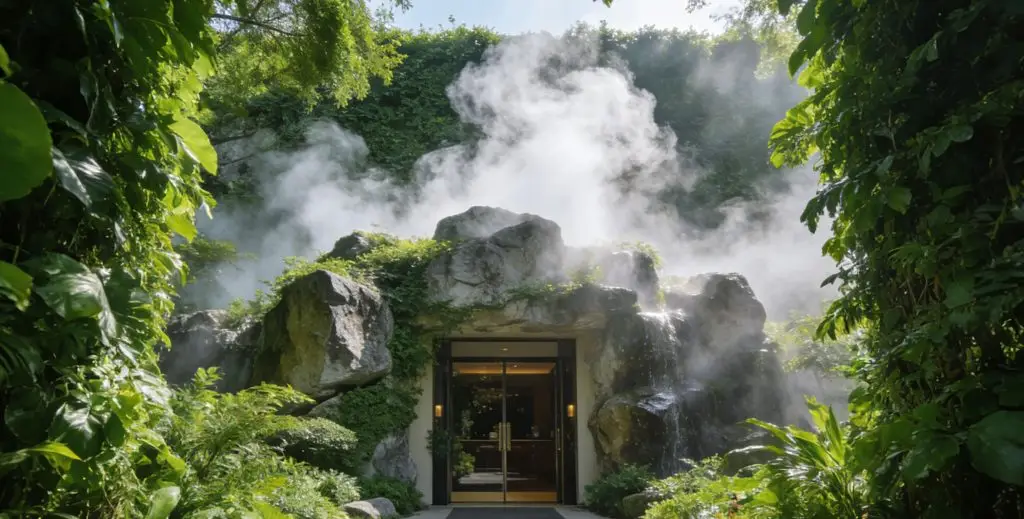
In the field of landscaping, industrial humidifiers help ensure the healthy growth of plants by maintaining an optimal humidity level (50% to 70%). This prevents leaf desiccation and browning of lawns, while also creating a misty effect that enhances the aesthetic appeal and comfort of the landscape. Proper humidification also helps suppress the growth of dust, mold, and mosquitoes, improves microclimates, and enhances the quality of the landscape environment and visitor experience.
In this article, we’ll explore why landscaping industry use industrial humidifiers, the benefits of proper humidity control, and how the right humidification system can optimize cloth production.
Why is humidity control so crucial for the landscaping industry?
In the field of landscaping, landscapes are primarily composed of green plants, lawns, water bodies, and artificial structures. For example, the landscape design of hotel gardens, commercial plazas, or theme parks is highly sensitive to humidity. Plants typically require a relative humidity of 50% to 70% during growth and viewing periods. Low humidity can cause leaves to wither and branches to dry out, lawns to turn yellow, water bodies to evaporate faster, and landscapes to appear dry and faded. High humidity can lead to the growth of mold, algae, and the proliferation of mosquitoes, affecting both environmental hygiene and aesthetics. By properly controlling humidity, it is possible to maintain healthy plant growth, enhance the aesthetic appeal of green plants, create a comfortable and pleasant microclimate, and achieve effective water mist effects, thereby improving the overall quality of the landscape and the visitor experience. If humidity control is inadequate, landscape plants may be damaged, water mist effects may be poor, and environmental hygiene may decline, ultimately affecting the aesthetic appeal and maintenance costs of the landscape.
What are the primary challenges posed by low humidity for the landscaping industry?
1. Plant growth is hindered
Dry air causes plants’ leaves to lose moisture, turn yellow, and wither, leading to wilted branches and foliage, which diminishes their aesthetic appeal.
The lawn and flowers are experiencing water shortages, leading to slow growth and a decline in the overall color and texture of the landscape.
2.Poor landscape microclimate
Insufficient humidity accelerates the evaporation of water bodies, reduces the effectiveness of mist and cooling, and diminishes the comfort level for visitors.
3. Increase in pests, diseases, and mold
A dry environment can lead to an increase in the activity of certain pests, while fluctuating humidity levels may also contribute to the growth of mold or algae, thereby affecting environmental hygiene.
4. Decreased aesthetic value of the landscape
The lack of misty scenery diminishes the visual depth and atmosphere of the landscape, resulting in a less aesthetically pleasing overall appearance.
5. Increased maintenance costs
Due to frequent plant wilting or disease outbreaks, there is a need for increased watering, pruning, and maintenance efforts, which increases labor and resource costs.
6. Tourist experiences are impacted
Environments characterized by dryness, oppressive heat, or barren landscapes can reduce visitor comfort and satisfaction, thereby diminishing the appeal of tourist sites or gardens.
Benefits of Industrial Humidifiers in landscaping industry
Installing an industrial humidification system provides several key advantages for landscaping industry:
Maintain plant health
Keep the humidity level appropriate, prevent leaves from drying out and the lawn from turning brown, and promote the growth of green plants.
Enhance the aesthetic appeal of the landscape
Create a misty effect to add depth and atmosphere to the scenery.
Enhance microclimates
Regulate air humidity to improve visitor comfort and environmental suitability.
Suppresses pests and diseases
Reduces the growth of mold, algae, and pests, maintaining the cleanliness of the landscape.
Lower maintenance costs
Reducing plant wilting and disease, thereby decreasing the workload associated with watering, pruning, and other maintenance tasks.
Enhance visitor experience
create more comfortable and aesthetically pleasing landscape environments to increase the appeal of scenic spots or gardens.
Types of Industrial Humidifiers Used in Landscaping Industry
Different humidification technologies are used depending on factory size and production requirements.
High-Pressure Mist Humidifiers
The water is converted into extremely fine particles by a high-pressure pump, which quickly evaporates, covering a large area of the landscape.
Ideal for creating mist effects in hotel gardens, shopping plazas, and large tourist attractions.
Ultrasonic Humidifiers
Ultrasonic oscillation is used to convert water droplets into extremely fine particles, resulting in low energy consumption and fine droplets.
Ideal for use in greenhouse landscapes, indoor gardens, or specific areas of landscaping.
Steam humidifier
The process involves heating to generate steam, thereby increasing air humidity, with high precision in humidity control.
Ideal for indoor landscapes or environments where high precision in humidity measurement is required.
Wet-film humidifier
The use of a wet-film evaporator increases the humidity of the air while also providing a cooling effect.
Ideal for use in greenhouses, outdoor gardens, or landscaping areas where a gentle cooling effect is desired.
Centrifugal humidifier
The water is dispersed into a mist-like state by rotating the centrifugal disc, ensuring even humidification.
Ideal for small to medium-sized landscaping areas or projects with limited budgets.
How to Choose the Right Humidification System for a Landscaping Industry?
When selecting an industrial humidifier for landscaping industry ,several factors should be considered:
- Scale of the landscape and spatial layout
- Aerosolization effects and viewing requirements
- Required humidity range
- Environmental and safety requirements.
Maintenance and operational costs - Local or global humidification
Working with an experienced humidification supplier can help determine the most suitable solution for your specific landscaping industry environment.
Conclusion
Humidity control is also crucial in the field of landscaping, but it is often overlooked. Industrial humidifiers can maintain an optimal level of humidity, ensuring the healthy growth of plants, preventing leaf desiccation and browning of lawns, while also creating a misty landscape effect that enhances the aesthetic appeal of the scenery.
By installing an efficient humidification system, landscaping projects can improve microclimates, enhance visitor experiences, and reduce the incidence of plant diseases and pests, thereby ensuring the quality of the landscape and improving maintenance efficiency.
As the technology of garden design and landscaping continues to advance, industrial humidifiers will remain an essential component of modern landscaping environments.